
 8 mins read
Human resources is experiencing a revolution. As we approach 2026, the conversation around AI for Employee Engagement has shifted from a theoretical possibility to a practical necessity. Today's HR leaders face unprecedented challenges: distributed workforces, rising mental health concerns, and the constant pressure to do more with less. The answer is not working harder - it is working smarter.
When organizations use AI for Employee Engagement, they are not replacing human connection; they are amplifying it. AI handles the heavy lifting of data analysis and pattern recognition, freeing HR professionals to focus on what they do best: building genuine relationships and fostering thriving workplace cultures.
Modern AI for Employee Engagement transforms HR from a reactive function into a proactive force. Instead of discovering problems after they have escalated, AI-powered systems detect early warning signs of disengagement, burnout, and turnover risk. This shift from process automation to human connection enhancement represents the true promise of AI-driven employee engagement.
TL;DR
- AI for Employee Engagement is now a core HR priority in 2026, turning data into timely action.
- AI amplifies human empathy by automating insights, not replacing managers or HR professionals.
- Predictive analytics and AI sentiment analysis HR identify burnout and turnover risks early.
- Industry surveys show a clear uplift in employee satisfaction AI metrics when AI is thoughtfully embedded.
- employee wellbeing AI and personalized wellness journeys boost retention and program participation.
- Ethical, transparent deployment and HR-IT collaboration are essential for successful adoption.
Why AI-Powered Engagement Matters for HR in 2026
The emergence of workflow-native AI assistants has fundamentally changed workplace dynamics. For teams onboarding new talent, AI-driven support and knowledge assistants are already reshaping HR workflows and helping fresh hires ramp faster while reducing repetitive administrative tasks. These tools integrate into everyday platforms to reduce friction and free humans for higher-value interactions.
AI for Employee Engagement excels at prediction. By analyzing communication patterns, project completion rates, and collaboration metrics, these systems identify employees at risk of burnout before visible symptoms appear. One manufacturing team reduced turnover by 23% after implementing predictive analytics that flagged overwhelmed team members, enabling timely manager interventions.
Industry studies report that a substantial share of employees feel more engaged when AI supports HR processes.
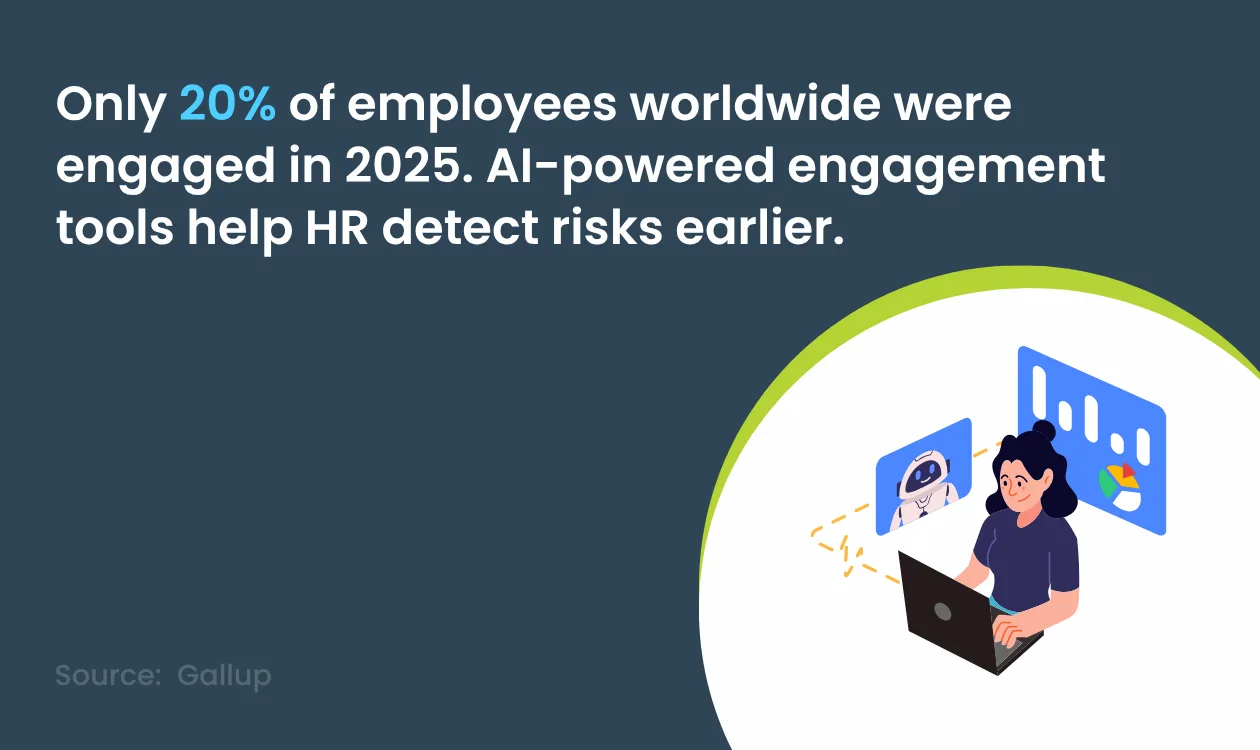
Employee engagement remains one of HR’s biggest business challenges. Gallup’s State of the Global Workplace 2026 report found that only 20% of employees worldwide were engaged in 2025, while low engagement cost the global economy an estimated ? trillion in lost productivity. This makes AI-powered engagement tools, pulse surveys, sentiment analysis, and HR analytics more valuable for identifying engagement risks early and improving workforce wellbeing.
Founder Reports' Employee Engagement Report shows that 51% of workers say they do only what is required, or even less.
About 65% of employees report higher engagement when AI is embedded into HR processes, according to recent surveys.
Personalization drives retention, and AI for Employee Engagement delivers customization at scale. Machine learning algorithms analyze individual preferences, career aspirations, and work styles to recommend tailored development opportunities, recognition approaches, and wellness resources. When employees feel seen and supported as individuals, engagement naturally follows.
Success stories are common across sectors. A healthcare organization using AI-powered engagement solutions saw satisfaction scores jump within six months after marrying real-time sentiment signals with manager-led check-ins that felt authentic rather than mechanical.
Employee Engagement AI Tools to Watch in 2026
Agentic AI platforms and workflow co-pilots lead the pack in 2026. These solutions integrate with everyday collaboration and HR systems to analyze communication flows, suggest workload balancing, and automate low-value admin tasks. The best options prioritize privacy, explainability, and seamless integration with your HR tech for engagement strategy.
AI in HR extends beyond analytics. Modern chatbots and virtual assistants provide 24/7 support for common HR questions, benefits enrollment, and policy clarification. The best systems use natural language processing to deliver empathetic, contextually appropriate responses that employees actually appreciate, improving the digital employee experience.
Predictive sentiment analysis tools scan multiple data sources - surveys, collaboration platforms, productivity metrics - to create comprehensive engagement portraits. These AI-driven analytics solutions do not just report current states; they forecast trends and recommend timely interventions that managers can act on.
Selecting the right tools requires clarity on objectives. Start with specific pain points: Are you struggling with feedback collection? Wellness program participation? Career development? Match AI engagement platforms to your actual needs, not vendor promises, and test early with pilot groups to measure real impact.
Advanced AI Strategies to Maximize Employee Engagement
The future belongs to hybrid intelligence teams where human insight meets AI-powered decision support. HR professionals provide context, emotional intelligence, and ethical judgment while AI delivers pattern recognition, predictive modeling, and scalable personalization.
AI for employee motivation works best when customized. Analytics reveal which recognition types resonate with individual employees: public praise, private notes, tangible rewards, or growth opportunities. Career development programs powered by AI match employees with stretch assignments, mentors, and learning resources aligned with their unique trajectories.
Real-time feedback mechanisms transform employee engagement with AI. Instead of annual surveys that capture outdated information, continuous pulse checks provide dynamic insights. AI aggregates this data, identifies themes, and alerts leaders to emerging concerns before they become crises, leveraging AI sentiment analysis HR to prioritize actions.
Ethics matter enormously. Transparent AI practices build trust. Employees need to understand what data is collected, how it is used, and how it protects their privacy. This clarity is especially crucial for fresh HR professionals who often struggle with early-career mistakes around communication, data handling, and employee expectations. Bias mitigation is not optional - it is fundamental to responsible use of AI in HR strategies.
AI for Workforce Wellbeing and Talent Retention
AI for employee wellbeing AI expands the scope of engagement to include mental health innovation and proactive support. Advanced systems detect language patterns indicating stress or overload in aggregated, privacy-safe ways. Rather than singling out individuals, these tools provide team-level insights and tailored wellness resource recommendations.
AI-powered wellness platforms create individualized health journeys. They consider personal goals, medical history, and preferences to suggest relevant programs, mindfulness exercises, and preventive care resources. One tech company reported higher wellness program engagement after implementing personalization driven by AI.
The key is integration with human-centered leadership. AI provides data and signals; empathetic managers transform that data into meaningful support. Technology enables humans to connect. Programs that pair AI recommendations with manager coaching and clear escalation paths see the strongest outcomes for employee satisfaction AI metrics.
Measuring Success: AI Analytics for Engagement and Well-Being
Modern metrics extend beyond traditional engagement scores. Two thousand twenty-six measurement frameworks include task productivity, well-being indicators, collaboration quality, and technostress monitoring. These comprehensive views reveal the true health of your workforce.
AI for workplace engagement dashboards visualize trends across teams, departments, and demographics. Predictive models forecast potential challenges three to six months ahead, enabling proactive interventions. When analytics show declining collaboration in a specific team, leaders can investigate and address root causes before performance suffers.
Strategic HR interventions guided by AI insights deliver measurable results, particularly when paired with structured employee engagement programs. Personalized growth plans, targeted recognition programs, and timely wellness support create virtuous cycles of engagement and productivity. Tracking outcomes through employee satisfaction AI KPIs helps quantify ROI and refine program design over time.
Preparing HR for the AI-Enhanced Future of Work
Building AI fluency requires hands-on experience. Developing future-ready HR skills will be essential as AI-driven tools become standard across every HR function. Encourage HR teams to experiment with available tools, attend workshops, and share learnings. Comfort with HR AI tools engagement grows through practice, not theory.
Cross-functional HR-IT partnerships ensure successful deployment. IT provides technical expertise; HR brings people knowledge. Together, they create AI-enhanced employee engagement systems that actually work in your organizational context. Clear governance, change management, and pilot-based learning reduce risks and accelerate value.
Ethical AI governance frameworks establish standards for responsible integration. Clear policies around data usage, algorithm transparency, and employee agency protect both organizations and individuals while maintaining a strong digital employee experience.
Conclusion
The imperative is clear: HR leaders must use AI for Employee Engagement strategically to unlock sustainable success. This is not about replacing human judgment with algorithms; it is about enhancing human capabilities with intelligent tools that elevate connection, well-being, and performance.
Organizations that thrive in 2026 and beyond will balance AI innovation with deeply human values. They will use technology to create workplaces where people feel valued, supported, and empowered to do their best work. Start by assessing your AI readiness, identifying high-impact pilots, and building governance that centers employee trust.
Ready to transform your approach? Assess your current AI readiness, identify high-impact opportunities, and build a roadmap for meaningful HR impact. The future of AI for Employee Engagement is here. Stay ahead of the curve - explore more HR insights on NextInHR.